
Dear community,
Thank you for your outpouring of well wishes, kindness, and patience as I go through the slow journey back from this spinal surgery. It will be a slow but steady pace back into full function but I’m so glad to have my team by my side and community support!
Just before my surgery I sent out a newsletter outlining the major pieces included in the Governor’s data center executive order (EO). I have heard some confusion of whether it replaced the Legislature’s omnibus bill completely, is a stop gap, has significant overlap, and many more questions. I hope this brief comparison clarifies all of these questions and confusions. At the end of the day the EO was a timely step and gets an important ball rolling but it does not replace the need for the legislation. Those conversations with the Governor continue.

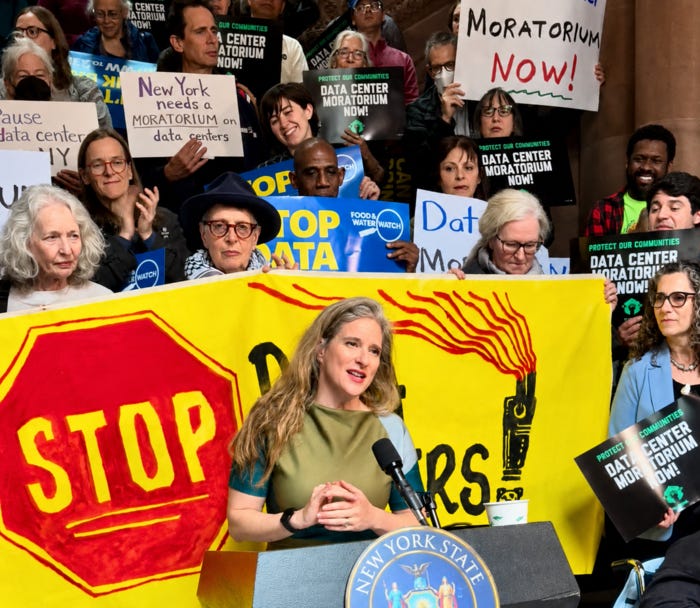
Why the Executive Order is important, but does not replace the Legislature’s data center omnibus bill A11560
New York now has two different approaches to addressing the rapid growth of large data centers: Governor Hochul’s Executive Order (EO) and the Legislature’s omnibus bill, A11560. While they share some common goals, they are fundamentally different in both scope and legal effect.
Many people have asked whether the Executive Order replaces the need for A11560. The short answer is that it does not.
Executive Order vs. Law
The Executive Order directs state agencies to study issues and develop future policies. A11560 requires many of those protections to be implemented in law. That means future administrations could change or rescind an Executive Order, while the protections established in law would remain in place unless changed by the Legislature.
This distinction also reflects New York’s constitutional balance of powers. The Executive Branch can direct state agencies through Executive Orders, while the Legislature establishes enduring public policy through statute. The Executive Order initiates agency action, but A11560 would make many of those protections permanent in law.
Statewide Environmental Review
Executive Order
Creates a temporary moratorium while the Department of Public Service (DPS) prepares a statewide Generic Environmental Impact Statement (GEIS).
According to the actual language of the EO, the moratorium remains in effect until the GEIS and findings statement are completed. However, the Governor has stated that this process will not exceed one year.
Requires public comment and at least one public hearing during preparation of the GEIS.
Directs DPS to evaluate energy demand, water use and quality, air quality, impacts on disadvantaged communities, and noise.
A11560
Requires a broader statewide environmental study and report additionally examining the impact of the boom in data center development on grid reliability, wastewater, greenhouse gas emissions, electronic waste, land use, farmland, forests, public health, Indigenous nations, infrastructure costs, and public subsidies.
Requires project-specific public hearings before permits are issued for large data centers so communities can review projected electricity demand, water use, environmental impacts, and public subsidies before decisions are made.
Requires a statewide environmental study and report rather than the GEIS required by the EO. This was intentional because the Legislature wanted to avoid creating a document that future data center projects could rely upon in place of their own more complete and required project-specific Environmental Impact Statement (EIS).
The Executive Order establishes a statewide review of large data centers before additional projects move forward. A11560 requires a broader review while also ensuring local communities have a formal opportunity to review individual projects and provide input before permits are issued.
Which Data Centers Are Covered?
Executive Order
Applies only to new or expanding data centers with a projected electric demand of 50 megawatts or more.
Exempts projects whose DEC permit applications were deemed complete before July 14, 2026, even if construction has not begun.
Exempts facilities primarily used for manufacturing, academic research, Empire AI, quantum research, biomedical research, and medical care.
A11560
Applies beginning at 20 megawatts because facilities below 50 megawatts can still have significant economic and environmental impacts.
Exempts only projects that had complete permit approvals and had already begun construction before the law took effect.
Excludes only facilities that are majority owned or controlled by a public research institution and used for research purposes.
The Executive Order applies to a smaller universe of projects than A11560. The Legislature intentionally chose a lower threshold because projects between 20 and 50 megawatts can still have substantial impacts on communities, utility infrastructure, and the environment.
Protecting Ratepayers
Executive Order
Directs the Department of Public Service (DPS) to study and explore ways to prevent the costs of serving large data centers from being shifted onto existing utility customers, including the possible creation of a Grid Acceleration Fund.
A11560
Requires the Public Service Commission (PSC) to establish a completely separate utility rate class so that the electric, drinking water, and wastewater costs attributable to serving large data centers are paid by those facilities rather than existing ratepayers.
The Executive Order directs agencies to develop possible solutions. A11560 establishes a solution in law by requiring infrastructure costs created by large data centers are assigned to those facilities instead of being shifted to homeowners, businesses, farms, and other utility customers.
Community Benefits
Executive Order
Directs Empire State Development (ESD), the economic development agency of the executive branch, to create a Community Investment Framework to help communities negotiate benefits with data center developers.
A11560
Requires large data centers to provide benefits to the communities where they locate through a Public Service Commission-approved host community benefit program, with annual independent audits to ensure those commitments are fulfilled.
The Executive Order encourages community benefits through future negotiations. A11560 makes those benefits a legal requirement.
Sustainability Standards
Executive Order
Directs agencies to consider future requirements for clean electric generation and battery storage dedicated to serving large data centers.
A11560
Establishes energy efficiency standards, renewable energy requirements, and labor standards for large data centers.
The Executive Order directs agencies to develop future policies. A11560 establishes those protections in law.
Water Resources
Executive Order
Directs DEC to review whether New York’s current water withdrawal regulations are sufficient to protect water resources as large data centers expand and to recommend any additional safeguards that may be needed. The fundamental question it asks is: “Are New York’s water withdrawal regulations adequate?”
A11560
Requires the statewide environmental review to evaluate how large data centers could affect water use, wastewater, and water quality across New York, but does not separately require DEC to review or update the State’s water withdrawal regulations. A11560 asks the fundamental question, “What are the cumulative impacts of data centers on water resources?”
These provisions address two fundamentally different, but equally important, questions. The Executive Order evaluates whether New York’s existing water withdrawal regulations are adequate as large data centers expand. A11560 evaluates how the cumulative impacts of data centers could affect water resources across the state.
These are complementary approaches, not competing ones. Together, they provide a more complete understanding of how to protect New York’s water resources. Ideally, both should be carried out and supported through law to establish a consistent, long-term commitment to safeguarding New York’s water resources as demand continues to grow.
Why A11560 is still relevant and important to sign into law
The Executive Order ensures that New York begins evaluating the impacts of large data centers before additional large projects move forward. That work is important.
However, the Executive Order does not replace A11560. The bill establishes broader environmental review, project-specific public participation, clear explicit protections for ratepayers, required host-community benefits, sustainability standards, and other safeguards in statute. Putting these protections into law provides long-term certainty and accountability while preserving the Legislature’s constitutional role in establishing public policy.
I’m relieved to hear of your progress in healing from the surgery. Let me know when you want to talk again!