
Dear Community,
Many of you have reached out to get more details on the data center moratorium bill that we passed through both houses at the end of session, so this newsletter is dedicated to summarizing it. Right now there are over 12 gigawatts worth of data center proposals in the queue at the New York Independent System Operator (NYISO), waiting for interconnection approval to connect to the New York grid. To put this in perspective, this is almost double the amount of energy consumed by every household in the state. Given the massive energy demand, and the documented noise, air, water, and soil pollution, as well as loss of farmland and electronic waste from data centers, the Legislature recognized that we could not adjourn for the year without addressing the impact data centers will have on our utility bills and environment.
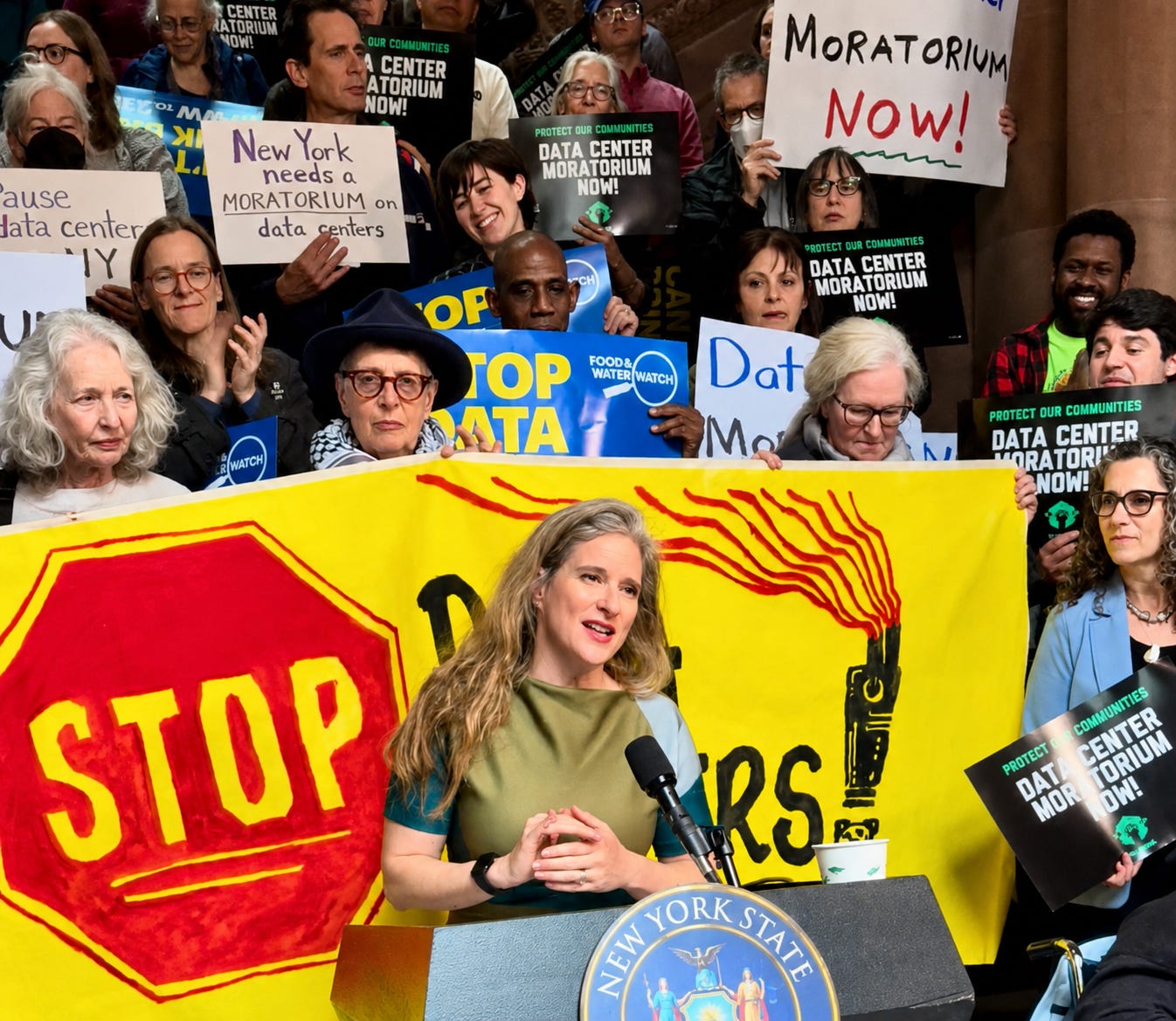
As you now know from previous newsletters, we had a very truncated policy season at the end of session as a result of the prolonged budget negotiations. To use our last week for policy as effectively and efficiently as possible, language from five separate data center bills was incorporated into one omnibus bill, including language from my data center moratorium. To hear my comments concerning the moratorium you can watch my speech at a May press conference here. For those who want a deep dive on the omnibus bill language you can read my white paper here.

A11560 is a comprehensive omnibus bill designed to establish New York’s first broad regulatory framework for the development of large-scale data centers. Rather than focusing on a single issue, the bill addresses many of the challenges presented by this rapidly growing industry, including electricity demand, electric grid reliability, water use, wastewater discharges, air pollution, greenhouse gas emissions, electronic waste, land use, public health, public subsidies, ratepayer protections, host-community benefits, and labor standards.
The omnibus combines and builds upon several previously introduced bills. It incorporates major concepts from three bills sponsored by myself, A10141, A9086, and A10852, as well as the ratepayer-protection framework from Assemblymember Didi Barrett’s A9039, the Accountability of Costs for Data Centers (AC/DC) Act, and the host-community benefit framework from Assemblymember Yudelka Tapia’s A9297. The bill also includes labor provisions that do not appear to derive directly from any of those measures.
Rather than simply combining these bills into a single package, A11560 refines many of their provisions, expands others, and creates a more integrated regulatory framework. In some cases it narrows earlier proposals, while in others it adds entirely new concepts. The result is legislation intended to ensure that as New York evaluates future data center development, decisions are made with a more complete understanding of the industry’s environmental, economic, infrastructure, and public health impacts. Below are the sections of the bill in summary:
Temporary one-year pause on permits for the largest new data centers
Temporarily pauses DEC permits for new data centers with a projected peak electric demand of 20 megawatts or more while the state studies the industry’s statewide impacts and develops a regulatory framework.
Does not affect existing data centers, permit renewals or modifications, or projects that have already begun construction.
Gives New York time to understand how rapid data center growth could affect the electric grid, water supplies, infrastructure, and surrounding communities before approving additional hyperscale facilities.
Statewide environmental impact report
Requires DEC to prepare New York’s first comprehensive study of the cumulative impacts of large data centers, including:
How much electricity existing and proposed data centers use, how they affect electric grid reliability, and whether new power plants, transmission lines, substations, or other infrastructure will be needed.
Water withdrawals, water consumption, wastewater generation, and impacts on rivers, lakes, aquifers, drinking water supplies, and wastewater treatment systems.
Greenhouse gas emissions, air pollution, backup generator emissions, and other climate impacts.
Noise, electronic waste, land use, farmland conversion, and impacts on forests and open space.
Public health impacts, including the combined effects of increased air pollution, water use, wastewater discharges, and noise.
Whether disadvantaged communities and Indigenous nations would experience disproportionate environmental or public health impacts.
State and local tax breaks, subsidies, and other public financial assistance provided to data center projects.
Recommendations for future laws or regulations based on the report’s findings.
Requires public hearings and an opportunity for public comment before the report is finalized.
Public participation and clean energy standards
Requires at least one in-person public hearing before DEC can approve a permit for a large new data center.
Requires developers to publicly disclose the project’s expected electricity demand, water use, wastewater generation, environmental impacts, and any state or local financial incentives they have received or applied for.
Directs state agencies to establish statewide energy-efficiency goals for designing and operating large data centers.
Requires data centers with a peak electric demand of 5 megawatts or more to gradually increase their use of renewable electricity, reaching at least 90% renewable power by 2040.
Requires facilities to generate as much renewable electricity on-site as practical and encourages recovery and reuse of waste heat whenever feasible.
Protecting ratepayers
Requires utilities to create a separate customer class for large data centers instead of treating them like other commercial or industrial customers.
Requires the costs of new electric, gas, water, and wastewater infrastructure needed to serve these facilities to be paid by the data centers creating the demand, rather than by households, small businesses, schools, farms, hospitals, or local governments.
Allows regulators to require financial guarantees, such as bonds or letters of credit, to protect utilities and ratepayers if a project is delayed, cancelled, or fails to meet its obligations.
Host-community benefits
Requires new large data centers, and major expansions of existing facilities, to invest directly in the communities where they are located.
Allows investments to include home energy improvements, community renewable energy projects, broadband, drinking water infrastructure, noise reduction, pollution reduction, and other locally identified priorities.
Requires a public process so residents and local governments help determine which community investments would provide the greatest benefit.
Requires independently audited annual reports showing that promised community benefits are actually being delivered.
Labor and workforce standards
Requires prevailing wages for construction of data centers.
Requires participation in registered apprenticeship programs whenever available, or workforce training where they are not.
Extends prevailing wage protections to certain workers who maintain and operate covered data center facilities.
Requires the use of domestically produced iron and steel for covered projects, with limited exceptions under existing law.
A11560 establishes New York’s first comprehensive framework for evaluating and regulating the development of hyperscale data centers.
Although A11560 incorporates major concepts from my bills A10141, A9086, and A10852, Assemblymember Barrett’s A9039 (the AC/DC Act), and Assemblymember Tapia’s A9297, it is more than a compilation of existing bills. The omnibus modifies, expands, and integrates those proposals into a single regulatory framework intended to help ensure that future data center development proceeds in a manner that protects New York’s electric grid, water resources, environment, workers, ratepayers, taxpayers, and host communities while providing policymakers with the information needed to make informed decisions as the industry continues to grow.